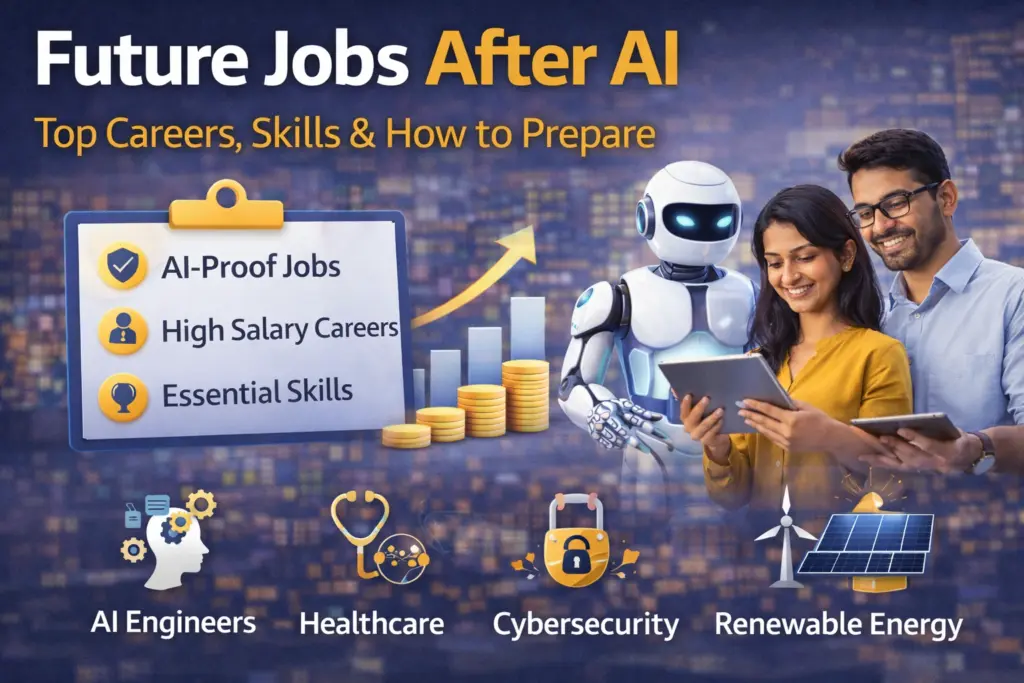
Future Jobs After AI: When examining the rapidly shifting dynamics of the global workforce, the conversation inevitably turns toward the impact of artificial intelligence. Discovering and preparing for future jobs after AI is no longer just a trend for tech enthusiasts; it has become a necessary survival strategy for every ambitious professional. The advent of generative AI, large language models, and advanced machine learning algorithms has fundamentally disrupted how businesses operate, creating a massive wave of anxiety regarding job security. However, while AI is undoubtedly automating routine and repetitive tasks, it is simultaneously giving birth to entirely new industries, roles, and economic opportunities.
Join our social media platform
The transition we are experiencing is similar to the Industrial Revolution, where the invention of the steam engine destroyed certain manual labor roles but created thousands of mechanical and engineering jobs. Today, securing your place in the modern workforce means heavily leaning into skills that machines cannot effortlessly replicate—such as deep emotional intelligence, complex strategic thinking, specialized manual dexterity, and advanced creative problem-solving. By proactively researching and transitioning into the best future jobs after AI, professionals can position themselves not just to survive the digital transformation, but to achieve unprecedented financial and career growth. In this comprehensive, in-depth guide, we will explore exactly which careers are future-proof, why they matter, and how you can prepare for them.
Why You Must Prepare for Future Jobs After AI Today
Waiting for the technological dust to settle before choosing your career path is a highly risky strategy. To remain competitive, you must actively pivot your skill sets toward future jobs after AI right now. The pace at which corporate enterprises are adopting automation algorithms is breathtaking, meaning the window to upskill is narrowing.
The Deep Impact of Automation on the Global Economy
Automation is aggressively sweeping through data entry, basic customer service, routine programming, and standard administrative tasks. Companies are recognizing that software can perform these duties faster and with near-zero error rates. Consequently, if your current role heavily involves rote memorization or repetitive data manipulation, you are in the high-risk zone. The shift toward future jobs after AI is driven by the corporate need for human oversight—people who can manage the machines, interpret their outputs with a nuanced understanding of human behavior, and enforce ethical guidelines.
Shifting Demands in Corporate Recruitment
Human Resource departments and corporate recruiters have radically altered their hiring rubrics. Degrees are still valuable, but cross-disciplinary skills have become the gold standard. A programmer who understands behavioral psychology or a healthcare provider who can navigate complex robotic diagnostic tools will always be heavily recruited. Preparing for future jobs after AI means stepping out of highly siloed academic disciplines and embracing a hybrid, continuously learning mindset.
Read also: How AI is Changing Jobs in India & What Young Professionals Should Do (2026 Guide)
The Top 12 Ultimate Future Jobs After AI Ensuring Career Security
If you are looking to pivot or start fresh, you need to target industries that are intrinsically safe from complete automation. Below is an extensively detailed list of the top 12 most definitive future jobs after AI that promise lucrative salaries, excellent job security, and long-term professional satisfaction.
1. AI Prompt Engineers and AI Whisperers
As AI models become more complex, they require highly skilled human operators to guide their outputs. Prompt engineering has rapidly emerged as one of the most highly sought-after future jobs after AI.
What Does an AI Prompt Engineer Do?
Generative AI models, despite their brilliance, require perfectly structured linguistic inputs to produce accurate, unbiased, and commercially viable results. Prompt engineers act as the interface between the raw algorithm and the final business application. They continuously refine, test, and tweak the text prompts given to AI systems to generate specific coding scripts, massive marketing campaigns, or complex legal summaries.
Why This Role is Future-Proof
AI cannot inherently know what an enterprise client wants. It requires a human “whisperer” who possesses high-level critical thinking, deep domain expertise, and a masterful grasp of language semantics. As long as AI models exist, organizations will need elite prompt engineers to tame and direct them, making this a highly lucrative pillar among future jobs after AI.
2. Machine Learning Architects and Maintenance Technicians
While AI automates software tasks, the physical and digital infrastructure running the AI still requires brilliant human minds. Transitioning into the architectural side of tech is a phenomenal way to secure your financial future.
The Architectural Responsibilities
Machine learning architects design the overarching frameworks that allow neural networks to process data efficiently. They choose the right algorithms, manage the immense cloud-computing resources required, and troubleshoot systemic failures. Furthermore, hardware maintenance technicians are needed to build, repair, and maintain the massive server farms and advanced quantum computers that power AI brains.
Career Trajectory
As one of the most highly compensated future jobs after AI, the demand for these technologists far exceeds the global supply. Because AI cannot invent entirely new, optimized physical hardware for itself yet, these roles remain safely in the human domain.
3. Empathy-Driven Healthcare Professionals
If there is one absolute truth about the digital revolution, it is that humans will always require a human touch when they are sick, vulnerable, or seeking mental health support. The medical sector offers a massive array of incredibly resilient future jobs after AI.
The Core Human Element
Nurses, physical therapists, occupational therapists, psychologists, and clinical social workers rely on deep empathy, reading subtle non-verbal cues, and providing physical comfort. While AI can certainly help a doctor diagnose a rare disease by analyzing an MRI scan in seconds, no machine can hold a patient’s hand, deliver difficult news with genuine compassion, or guide a trauma victim through cognitive behavioral therapy.
Long-Term Security
With an aging global population, the demand for healthcare workers is structurally built to grow. Exploring medical and therapeutic future jobs after AI ensures a career that is insulated from automation and deeply fulfilling on a personal level.
4. Strategic Data Scientists and Human-in-the-Loop Analysts
Wait, doesn’t AI do data analysis? Yes, but AI is exceptionally poor at understanding the nuanced, off-screen business context. This limitation preserves the role of the strategic data scientist.
The Strategic Difference
A traditional data entry clerk will be replaced, but a strategic data scientist is one of the most powerful future jobs after AI. These professionals look at the massive datasets compiled by AI, apply real-world geopolitical context, human economic behavioral trends, and corporate strategy to develop highly actionable business plans.
Growth Opportunities
Data science is pivoting from mathematical processing to advanced corporate consulting, requiring highly communicative, persuasive professionals, making this an exciting path for future jobs after AI.
5. Cybersecurity Analysts and AI Defense Specialists
As malicious actors leverage AI to create sophisticated zero-day attacks, massive data breaches, and highly convincing deepfake social engineering, companies and governments are drastically ramping up cybersecurity. Consequently, defensive roles are firmly positioned as premier future jobs after AI.
The Unrelenting Nature of Security
A cybersecurity analyst uses AI tools, but they also use human intuition to anticipate how a hacker might weaponize algorithms against their infrastructure. The responsibility is immense, requiring constant vigilance, rapid incident response, and legal compliance.
Global Demand
Cybersecurity roles often go unfilled globally due to a huge talent shortage, giving graduates and transitioners incredible leverage when negotiating salaries and benefits in the landscape of future jobs after AI.
6. Complex Problem Solvers and Business Transformation Consultants
AI is exceptional at optimizing known systems, but when a multi-national company faces an entirely novel crisis, such as a localized pandemic, a volatile political upheaval, or a completely new consumer behavior trend, AI lacks true situational reasoning. Management consulting is thus a cornerstone of powerful future jobs after AI.
Managing The Human Variable
Consultants assess corporate problems holistically, interviewing key stakeholders, resolving interpersonal conflicts, and aligning corporate resources to tackle unstructured, ambiguous problems.
Career Longevity
Because consulting relies heavily on deep empathy, social dynamics, lateral thinking, and highly complex stakeholder negotiation, the role remains securely human.
7. Robotics Engineers and Human-Robot Interaction Designers
While AI acts as the brain, robotics acts as the body. The intersection of these two fields will generate some of the most dynamic future jobs after AI. Integrating robotic systems into human workplaces without causing injury or friction is an immensely complex engineering challenge.
Specialized Interactions
Human-robot interaction designers map out how a manufacturing robot safely works alongside a human assembly line worker, or how a robotic surgical arm assists a top-tier surgeon securely. They focus on latency, physical safety mechanisms, and intuitive control interfaces.
Why Graduates Choose This Path
Robotics is a highly specialized sector that promises massive financial rewards and immense intellectual satisfaction among the list of future jobs after AI.
Read also: Career Options After Graduation: 15 Best & Proven Paths for 2026
8. Ethics Officers and AI Compliance Managers
Who is responsible if an autonomous vehicle causes a fatal accident? Who gets sued if a generative AI model plagiarizes a copyrighted novel? Managing the immense ethical and legal liabilities of AI creates highly prestigious future jobs after AI.
Safeguarding Corporate Integrity
AI ethics officers audit algorithms for racial, gender, or economic bias. They work with corporate lawyers to ensure that a company’s AI strategy heavily complies with rapidly changing global data privacy regulations, such as the GDPR in Europe.
Long-Term Stability
As governments inevitably crack down on unregulated AI usage, compliance and ethics will become non-negotiable departments in every Fortune 500 company, cementing this as one of the most critical future jobs after AI.
9. Creative Directors and Human-Centric Artists
While AI can generate stunningly accurate images in seconds or write a decent marketing jingle, it cannot intrinsically feel the emotional weight of a cultural moment. Art direction and high-level creative strategy remain deeply rooted as future jobs after AI.
The Essence of True Artistry
A machine generates what it has seen; a human generates what they feel. Creative directors harness AI as a rapid prototyping tool but ultimately rely on human lived experiences, emotional vulnerability, and cultural nuance to direct highly impactful ad campaigns, direct films, or design fashion lines.
The Work Environment
This career path provides an incredibly vibrant and collaborative work environment. Creativity will always command a massive premium in the pantheon of future jobs after AI.
10. Renewable Energy Technicians and Innovators
As the world urgently shifts away from fossil fuels, the green technology sector is exploding with profound opportunities. Combating climate change requires thousands of hands-on technical professionals, cementing renewable energy maintenance as one of the best physically active future jobs after AI.
Creating Sustainable Solutions
Solar panel installers, wind turbine technicians, and smart-grid battery engineers are incredibly difficult to automate because their daily tasks require complex physical dexterity, navigating highly unpredictable outdoor environments, and immediate problem-solving on the ground.
Market Growth
This rapidly expanding sector allows transitioning professionals to positively impact the planet while enjoying massive job security across a multitude of future jobs after AI.
11. Teachers, Mentors, and Human Development Coaches
Knowledge transfer might change, but the need for deeply encouraging, human-driven mentorship will not. Education and personal development provide fundamentally secure future jobs after AI.
The Human Connection
AI can deliver a personalized curriculum efficiently, but it cannot inspire a struggling high school student to believe in themselves. A human teacher notices when a student is exhausted, hungry, or grieving. Furthermore, adult professionals are increasingly seeking life coaches and highly experienced executive mentors to navigate their careers.
Stability and Impact
A talented, empathetic human leader has the power to drastically alter the trajectory of a person’s life, ensuring that teaching and coaching remain deeply respected and necessary future jobs after AI.
12. Complex Supply Chain Orchestrators and Global Trade Analysts
The efficient movement of physical goods is the lifeline of the modern economy. Logistics is a robust and strategic avenue when exploring highly lucrative future jobs after AI.
Key Logistics Operations
While AI can optimize a delivery route beautifully, it struggles massively when a physical cargo ship suddenly blocks a vital canal, or a pandemic shuts down a primary manufacturing hub overseas. Supply chain orchestrators negotiate instantly with global stakeholders, reroute physical ships manually when systems fail, and rebuild shattered vendor relationships.
Opportunities for Advancement
Because physical goods must traverse unpredictable physical environments, highly talented human logistics managers are rapidly promoted to senior operational roles across the globe, easily securing their place among the most stable future jobs after AI.
Essential Skills Needed for Future Jobs After AI
Now that you know the top industries, you must actively narrow down exactly what skills are required. Transitioning effectively into lucrative future jobs after AI is less about what facts you have memorized and heavily reliant on how you approach unstructured problems.
Focusing on Complex Critical Thinking
Generative text models provide answers instantly, but humans must be able to ask the right, incisive questions. Critical thinking involves highly structured evaluation, skepticism of data sources, and recognizing the massive biases inherent in AI datasets. This is arguably the most fundamental prerequisite for all future jobs after AI.
Elevating Emotional Intelligence (EQ)
Machines lack empathy. Your ability to heavily manage interpersonal conflicts, lead a diverse team through immense corporate stress, and sell a complex idea to a skeptical boardroom is entirely human. Roles requiring a high EQ are virtually immune to true automation, forming the solid bedrock of future jobs after AI.
Cultivating Extreme Adaptability and Continuous Learning
The technologies dictating the modern job market are shifting every six months. The most highly successful professionals in future jobs after AI do not view their university degree as the end of their education; they view it as the bare minimum. They continuously enroll in technical bootcamps, massively consume industry research, and rapidly adopt newly released tools to maintain their competitive edge.
Adapting Industries: Where Will Future Jobs After AI Be Created?
Choosing the right role is vital, but choosing the right industry is equally important. When targeting safe future jobs after AI, you should actively seek out sectors that are receiving massive capital injections from global venture capital and government subsidies.
Expanding the Tech Sector
The tech sector is no longer just software development; it has hybridized heavily. Ed-Tech (educational technology), Fin-Tech (financial technology), and bio-informatics are creating thousands of profoundly interesting hybrid future jobs after AI. Professionals who can bridge the gap between finance and machine learning, or biology and computational models, are highly sought after.
The Indestructible Healthcare Sector
As global life expectancies rise, the strain on healthcare infrastructures is immense. The integration of advanced telemedicine and robotic surgery requires an entire ecosystem of technical maintainers, empathic patient coordinators, and healthcare data analysts. This sector is heavily driving the massive growth of resilient future jobs after AI.
Resurgent Value in The Creative Industries
There is a massive cultural backlash against entirely AI-generated art, music, and literature. Consumers heavily crave authenticity, meaning human-made products, traditional craftsmanship, deep investigative journalism, and vulnerable human storytelling are experiencing a sudden massive premium. This guarantees highly lucrative future jobs after AI for true human creators.
Frequently Asked Questions About Future Jobs After AI
Will AI truly take all our jobs?
No. Artificial intelligence will heavily automate specific, highly routine tasks within a job, rather than eliminating entire professions immediately. The massive structural shift will ultimately replace jobs that require heavy rote memorization or basic data processing with entirely new future jobs after AI that demand complex critical and strategic thinking.
How can I proactively transition to future jobs after AI if I am currently in a highly automatable sector?
It is incredibly common for modern professionals to face career disruption through technology. If you find yourself in the wrong field, you can seamlessly pivot toward future jobs after AI by enrolling in intensive specialized bootcamps, securing deep cross-departmental mentorships within your current company, or pursuing highly targeted micro-credentials in data analytics, prompt engineering, or cybersecurity defense.
Should I choose stability or passion when pursuing future jobs after AI?
Your initial transition into future jobs after AI should ideally provide a careful balance. However, taking aggressively calculated risks—such as joining an unproven but highly innovative AI-ethics startup—is much safer to do today rather than waiting a decade when the entire corporate sector has fully integrated automation protocols. The key is to passionately develop skills that algorithms fundamentally cannot replicate.
Conclusion: Embracing Future Jobs After AI with Immediate Confidence
The transition caused by the global adoption of automation is a highly pivotal and intimidating moment for everyone. By thoughtfully and aggressively exploring these extensively vetted future jobs after AI, you are heavily ensuring the necessary groundwork for a thriving, comfortable, and deeply fulfilling life. Do not let the massive pressure of incoming automation force you into highly stagnant obsolescence.
Take an immense amount of time today to investigate these top 12 proven corporate paths, continuously and obsessively acquire robust new skill sets, and remain highly adaptable to constant industry shifts. No matter what your current degree specializes in, the modern global marketplace consistently offers a massive wealth of dynamic opportunities for those who are prepared and radically determined. Your economic future inherently relies on the aggressive educational choices you make today—so review your available future jobs after AI strategically, refine your innate human empathy and critical thinking, and forcefully enter the robotic age with absolute strategic confidence.
Read more
- What to know before playing pokies at Online Casino Australia 2026: Essential tips
- Best Non GamStop Casino Sites revealed: explore fast and secure payout methods for UK
- Neosurf Casinos Australia revealed: How to maximize your gaming experience with quick deposits
- The ultimate review of PayID Pokies Australia: cashout options and gameplay insights
- Fast Withdrawal Casino features: discover top games for instant payouts